Poets' Corner

Share Poets' Corner on Facebook Share Poets' Corner on X (formerly Twitter) Share Poets' Corner on Linkedin Email Poets' Corner link

Poets' Corner - What is it about?

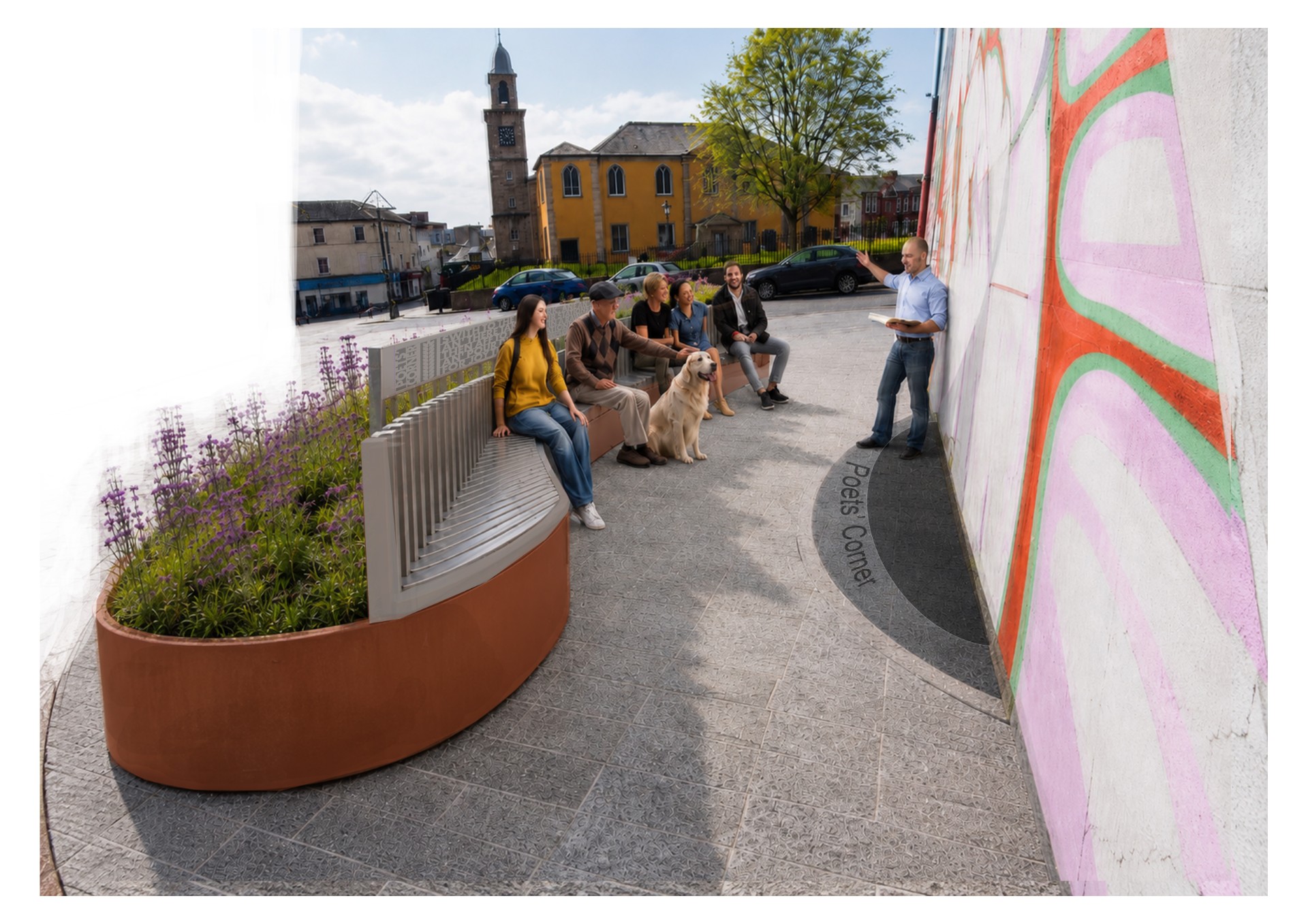
“Small space improvement at the corner of John Dickie Street and Strand Street. Planters integrated into street furniture, potential additional elements of hard landscaping giving support to the activity of “Spoken Word” and events throughout the year. Inclusion of inscribed poet.”

Where is it?

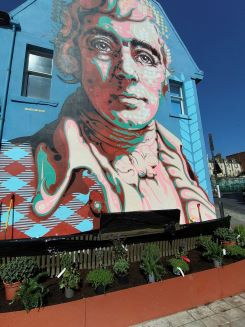
Poets' Corner sits on the corner at 3A John Dickie Street, Kilmarnock, KA1 1HW. It lies directly below the Robert Burns Mural on the gable end of the Civic Centre North building.

Background

The Robert Burns Mural was commissioned by East Ayrshire Council and delivered in partnership with East Ayrshire Leisure Trust, and the Robert Burns World Federation who are tenants of the Civic Centre North Building. The renowned artist Michael Corr designed and installed the mural following community consultation, and his own research.

On 29 August 2024, East Ayrshire Council passed a motion at a full council meeting which stated:

“We further recommend that the Kilmarnock Strategic Group investigates the feasibility of developing and enhancing the street corner in front of the new Robert Burns mural into a ‘Poets’ Corner’ as a base to promote ‘spoken word’ events, while also formally recognising and celebrating the John Wilson printing of Burns’s 'Kilmarnock Edition’ of poems.”

As a result, the Kilmarnock Strategic Group set up a sub group which met in May, June, and August 2025, to clarify the brief, identify options, and investigate, feasibility of those options. The sub-group comprised representatives from east Ayrshire leisure, council officers and elected members.

At their last meeting in August 2025 agreed to install two planters with Poets’ Corner lettering and two curved metal benches with cut metal backs showing the Burns Poem "The Ordination" on the back.

Aspirations and approach

East Ayrshire Council is currently developing a Master Plan for the town centre. A phased approach will be taken to create significant regenerative change.

This includes the area around the mural, so thought has been given to how the materials used – street furniture, paving and planting - will tie into the projects throughout the Town Centre giving uniformity and theme, specifically, its relationship to Wallace Chambers, the Foregate Civic Space and Spanish Steps at the Palace Theatre.

The design incorporates soft-landscaping in a planter to assist in developing an increase in biodiversity to the urban landscape of Kilmarnock. The implementation of improved green civic spaces is in keeping with wider aspiration of ‘green corridors’ around the town.

Key features include actively selecting native hardy perennial planting with reference to Burns’ poetry and plants that would have been familiar to Burns and his companions.

What happens now?

Work on the new area will begin on 19 June, with temporary traffic lights appearing on the corner of John Dickie Street and Strand Street to keep the traffic flowing during the installation. Resurfacing work will be done at night for three nights starting at 11pm on Friday 19 June to avoid disruption as much as possible.

On 22 May work will begin on the pavement in front of the Mural to create the foundations for the bench and resurface with dropped kerbs and matching pavers.

Crane

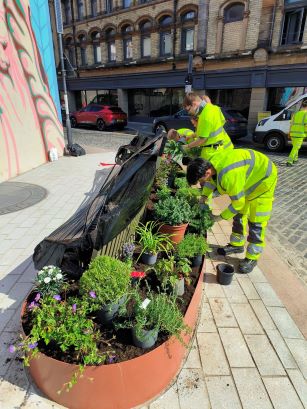
On 1 July the new bench incorporating the metal panel with Burns' The Ordination will be hoisted into place by crane and signage will be installed with details and links to more information.

At this point our Greener Communities team will fill the planters ahead of completion on 17 July.

What next?

Watch this space for a programme of activities and events around the town centre featuring Poets' Corner as just one of our coming new town centre attractions. And if you're a budding poet, you'll have a chance to add your work to our Poets' Corner "Post a Poem" archive.


Local Poets

The Poets' corner will be placed in front of the mural depicting Robert Burns but there are other notable local Poets who feature in our local history.

Have we missed any? Get in touch to let us know.


Stewart Conn

Stewart's Father was Reverend Dr John Conn and he was appointed minister of St Marnock's Church in 1942. Stewart Conn attended Kilmarnock Academy and on May 30th 2002 he was honoured as the first Edinburgh Makar (poet laureate of the city).

More information on Stewart

Stewart Conn's Poems

Alexander Smith

“Alexander Smith was the eldest of six children born to John Smith and his wife Christina Murray, only two of whom outlived them. Alexander was born on 31 December 1829 in Kilmarnock, where his father designed printing blocks for calico and muslin. Shortly after the birth of a daughter the family moved to Paisley and in around 1838 they arrived in Glasgow.”

There is a memorial to him located at his birthplace on Douglas Street, Kilmarnock at the rear of the Galleon Centre, next to the Howard Park.

More information on Alexander Smith.

Archibald McKay

Archibald McKay was born in the Townhead district of Kilmarnock on 28 June 1801, son of Alexander McKay of Kildonan, and Janet McGill, daughter of a Kilmarnock shoemaker.

He is noted for writing the "History of Kilmarnock" published in 1858, of which there were a subsequent four editions, and the poem "My Frist Bawbee"

More information on Archibald McKay

Edgar Allan Poe

Poe's links to Kilmarnock are indirect but in historical terms are credible.

Edgar Allan Poe spent part of his childhood in Ayrshire after arriving in 1815 with his foster father, John Allan, who was born in the region. He lived mainly in Irvine, where he attended grammar school and stayed with Allan family relatives. While there, Poe also visited nearby Kilmarnock, where other members of the Allan family lived, linking him indirectly to the town. Early accounts describe his experiences among these relatives and local surroundings, which may have influenced his later writing. Today, this brief but significant period is recognised as part of Poe’s formative years and Ayrshire’s literary heritage.

There is a plaque as part of the Kilmarnock heritage Trail dedicated to him at Grange Place.

Kilmarnock Heritage Trail

More information on Edgar Allan Poe

Isabel "Tibbie" Pagan

Isabel “Tibbie” Pagan (c. 1740–1821) was a Scottish working‑class poet from Ayrshire, born near New Cumnock. Despite physical disabilities, she built a reputation as a lively performer, earning a living by singing her own songs and hosting gatherings in her small cottage, which became a popular local meeting place. Known for her sharp wit and satirical verse, she often mocked those who offended her. Because she could not write, others recorded her poetry for her. Her best‑known song, Ca’ the Ewes to the Knowes, was later adapted by Robert Burns. Pagan remains an important figure in Scotland’s folk and literary tradition.

There is a mural dedicated to her in Muirkirk

More information on Tippie Pagan

Lorna Wallace

Lorna is a local poet noted for her poem written in scots "Tae a Selfie"

Tae a Selfie by Lorna Wallace

Poets' Corner - What is it about?

“Small space improvement at the corner of John Dickie Street and Strand Street. Planters integrated into street furniture, potential additional elements of hard landscaping giving support to the activity of “Spoken Word” and events throughout the year. Inclusion of inscribed poet.”

Where is it?

Poets' Corner sits on the corner at 3A John Dickie Street, Kilmarnock, KA1 1HW. It lies directly below the Robert Burns Mural on the gable end of the Civic Centre North building.

Background

The Robert Burns Mural was commissioned by East Ayrshire Council and delivered in partnership with East Ayrshire Leisure Trust, and the Robert Burns World Federation who are tenants of the Civic Centre North Building. The renowned artist Michael Corr designed and installed the mural following community consultation, and his own research.

On 29 August 2024, East Ayrshire Council passed a motion at a full council meeting which stated:

“We further recommend that the Kilmarnock Strategic Group investigates the feasibility of developing and enhancing the street corner in front of the new Robert Burns mural into a ‘Poets’ Corner’ as a base to promote ‘spoken word’ events, while also formally recognising and celebrating the John Wilson printing of Burns’s 'Kilmarnock Edition’ of poems.”

As a result, the Kilmarnock Strategic Group set up a sub group which met in May, June, and August 2025, to clarify the brief, identify options, and investigate, feasibility of those options. The sub-group comprised representatives from east Ayrshire leisure, council officers and elected members.

At their last meeting in August 2025 agreed to install two planters with Poets’ Corner lettering and two curved metal benches with cut metal backs showing the Burns Poem "The Ordination" on the back.

Aspirations and approach

East Ayrshire Council is currently developing a Master Plan for the town centre. A phased approach will be taken to create significant regenerative change.

This includes the area around the mural, so thought has been given to how the materials used – street furniture, paving and planting - will tie into the projects throughout the Town Centre giving uniformity and theme, specifically, its relationship to Wallace Chambers, the Foregate Civic Space and Spanish Steps at the Palace Theatre.

The design incorporates soft-landscaping in a planter to assist in developing an increase in biodiversity to the urban landscape of Kilmarnock. The implementation of improved green civic spaces is in keeping with wider aspiration of ‘green corridors’ around the town.

Key features include actively selecting native hardy perennial planting with reference to Burns’ poetry and plants that would have been familiar to Burns and his companions.

What happens now?

Work on the new area will begin on 19 June, with temporary traffic lights appearing on the corner of John Dickie Street and Strand Street to keep the traffic flowing during the installation. Resurfacing work will be done at night for three nights starting at 11pm on Friday 19 June to avoid disruption as much as possible.

On 22 May work will begin on the pavement in front of the Mural to create the foundations for the bench and resurface with dropped kerbs and matching pavers.

Crane

On 1 July the new bench incorporating the metal panel with Burns' The Ordination will be hoisted into place by crane and signage will be installed with details and links to more information.

At this point our Greener Communities team will fill the planters ahead of completion on 17 July.

What next?

Watch this space for a programme of activities and events around the town centre featuring Poets' Corner as just one of our coming new town centre attractions. And if you're a budding poet, you'll have a chance to add your work to our Poets' Corner "Post a Poem" archive.


Local Poets

The Poets' corner will be placed in front of the mural depicting Robert Burns but there are other notable local Poets who feature in our local history.

Have we missed any? Get in touch to let us know.


Stewart Conn

Stewart's Father was Reverend Dr John Conn and he was appointed minister of St Marnock's Church in 1942. Stewart Conn attended Kilmarnock Academy and on May 30th 2002 he was honoured as the first Edinburgh Makar (poet laureate of the city).

More information on Stewart

Stewart Conn's Poems

Alexander Smith

“Alexander Smith was the eldest of six children born to John Smith and his wife Christina Murray, only two of whom outlived them. Alexander was born on 31 December 1829 in Kilmarnock, where his father designed printing blocks for calico and muslin. Shortly after the birth of a daughter the family moved to Paisley and in around 1838 they arrived in Glasgow.”

There is a memorial to him located at his birthplace on Douglas Street, Kilmarnock at the rear of the Galleon Centre, next to the Howard Park.

More information on Alexander Smith.

Archibald McKay

Archibald McKay was born in the Townhead district of Kilmarnock on 28 June 1801, son of Alexander McKay of Kildonan, and Janet McGill, daughter of a Kilmarnock shoemaker.

He is noted for writing the "History of Kilmarnock" published in 1858, of which there were a subsequent four editions, and the poem "My Frist Bawbee"

More information on Archibald McKay

Edgar Allan Poe

Poe's links to Kilmarnock are indirect but in historical terms are credible.

Edgar Allan Poe spent part of his childhood in Ayrshire after arriving in 1815 with his foster father, John Allan, who was born in the region. He lived mainly in Irvine, where he attended grammar school and stayed with Allan family relatives. While there, Poe also visited nearby Kilmarnock, where other members of the Allan family lived, linking him indirectly to the town. Early accounts describe his experiences among these relatives and local surroundings, which may have influenced his later writing. Today, this brief but significant period is recognised as part of Poe’s formative years and Ayrshire’s literary heritage.

There is a plaque as part of the Kilmarnock heritage Trail dedicated to him at Grange Place.

Kilmarnock Heritage Trail

More information on Edgar Allan Poe

Isabel "Tibbie" Pagan

Isabel “Tibbie” Pagan (c. 1740–1821) was a Scottish working‑class poet from Ayrshire, born near New Cumnock. Despite physical disabilities, she built a reputation as a lively performer, earning a living by singing her own songs and hosting gatherings in her small cottage, which became a popular local meeting place. Known for her sharp wit and satirical verse, she often mocked those who offended her. Because she could not write, others recorded her poetry for her. Her best‑known song, Ca’ the Ewes to the Knowes, was later adapted by Robert Burns. Pagan remains an important figure in Scotland’s folk and literary tradition.

There is a mural dedicated to her in Muirkirk

More information on Tippie Pagan

Lorna Wallace

Lorna is a local poet noted for her poem written in scots "Tae a Selfie"
Tae a Selfie by Lorna Wallace

Page last updated: 06 Jul 2026, 10:37 AM